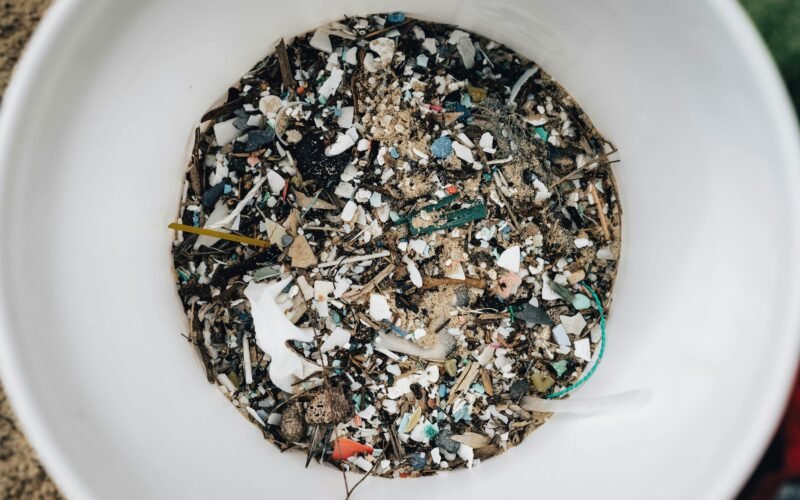

You’ve decided you want to do something about microplastics in your drinking water. Smart move. But now you’re staring at two very different options: a $35-$90 pitcher filter you can buy at any big box store, or a reverse osmosis system that costs anywhere from $90 to $500 and might involve plumbing. Which one actually works and which one is right for your home, your budget, and your life?
This post breaks it all down with no fluff. We’ll cover how each technology works, what the science says about microplastic removal, real costs over time, and a simple decision framework so you can pick the right filter for your situation.
The Short Answer
Reverse osmosis removes more microplastics, period. Its membrane pore size is 0.0001 microns, thousands of times smaller than even the tiniest microplastic fragments, making it the gold standard for microplastic reduction. A certified pitcher filter can do a solid job too, but performance varies enormously depending on the specific model and how it’s certified. Most standard pitchers (think basic Brita) were never designed to remove microplastics at all.
But “more effective” doesn’t automatically mean “right for you.” A pitcher might be the better fit depending on your living situation, budget, and how much water your household actually drinks. Let’s dig in.
How Each Technology Works
Pitcher Filters
Most pitcher filters use activated carbon, a highly porous material that attracts and traps chemical contaminants like chlorine, some heavy metals, and VOCs as water passes through. This is why filtered water tastes so much better: the carbon is pulling out the stuff that makes water smell and taste off.
The problem for microplastics is pore size. Standard carbon filter pores are typically 0.5-1.0 microns in diameter. Microplastics range from about 1 micron to 5 millimeters, which means many of the smaller fragments can slip right through a standard carbon filter. Think of trying to catch grains of sand with a fishing net, some will get caught, but a lot won’t.
However, not all pitchers are the same. Some advanced pitchers, like the Clearly Filtered Pitcher, use a proprietary sub-micron filtration media that goes well beyond basic carbon, and have been independently tested to remove 99.99% of microplastics. These aren’t your average grocery store filters.
Reverse Osmosis (RO)
Reverse osmosis works differently. Instead of chemical adsorption, it uses physical pressure to force water through a semi-permeable membrane with pore sizes around 0.0001 microns, that’s roughly 5,000 times smaller than a typical activated carbon pore. At that scale, microplastics simply cannot pass through. Neither can most dissolved salts, heavy metals, PFAS, nitrates, or the vast majority of other contaminants.
Most RO systems use multiple stages: a sediment pre-filter, one or more carbon stages to protect the membrane from chlorine, the RO membrane itself, and sometimes a post-filter or remineralization stage to restore trace minerals stripped by the process.
Research consistently shows that RO membranes remove 99% or more of microplastics from drinking water, including sub-micron particles that certified pitcher filters may still miss.
The Certification Question: What to Actually Look For
This is where a lot of consumers get misled. Many filters claim to “reduce microplastics” on their packaging. That claim means almost nothing without an independent certification behind it.
Here’s what actually matters:
- NSF/ANSI 401: The primary certification for emerging contaminants including microplastics. To pass, a filter must demonstrate at least 85% reduction of particles in the 0.5–1.0 micron range under controlled lab conditions. This is the baseline trust signal to look for on any filter you’re buying for microplastic reduction.
- NSF/ANSI 244: A newer standard specifically designed for microplastic reduction. Very few pitchers currently carry it, but it’s more precise than 401 for this use case.
- NSF/ANSI 58: The performance standard for reverse osmosis systems. If an RO system also carries NSF 401, you have verification of microplastic reduction on top of overall RO performance.
One important nuance: a filter being “tested to NSF standards” is not the same as being “certified to NSF standards.” Certification requires ongoing third-party auditing. Testing is a one-time snapshot. When in doubt, verify the specific model number directly at nsf.org.
Head-to-Head Comparison
| Certified Pitcher Filter | Reverse Osmosis | |
|---|---|---|
| Microplastic removal | Up to 99.99% (certified models only) | 99%+ consistently |
| Pore size | 0.5 microns (advanced models) | 0.0001 microns |
| PFAS removal | Partial (depends on model) | 95–99%+ |
| Heavy metals | Good (certified models) | Excellent |
| Installation | None — just fill and pour | Countertop (no plumbing) or under-sink |
| Upfront cost | $90–$100 | $349–$449 (countertop RO) |
| Annual filter cost | ~$120–$150/year | ~$100–$170/year |
| Filter life | 100 gallons (~3–4 months) | 6–24 months depending on stage |
| Water output speed | Slow (gravity-fed) | Fast (countertop RO) to instant (under-sink) |
| Renter-friendly | Yes | Yes (countertop) / Varies (under-sink) |
| Remineralization | Minerals retained | Strips minerals (some models add back) |
| Wastewater produced | None | Some (modern tankless RO is more efficient) |
The Real Cost Picture
Upfront price is only part of the story. Here’s how the math actually shakes out over time:
Pitcher Filter (e.g., Clearly Filtered)
- Upfront: ~$90
- Replacement filters: ~$150/year (100-gallon filter life, 3–4 filters/year)
- Cost per gallon: ~$0.15
- Year 1 total: ~$240
Countertop RO (e.g., AquaTru Carafe)
- Upfront: ~$449
- Annual filter cost: ~$100/year
- Cost per gallon: ~$0.25
- Year 1 total: ~$549 | Year 2+: ~$100/year
Under-Sink RO (e.g., Waterdrop G3P800)
- Upfront: ~$349–$499
- Annual filter cost: ~$170/year
- Cost per gallon: ~$0.16–$0.23
- Year 1 total: ~$520–$670 | Year 2+: ~$170/year
If you’re currently spending $40–$80/month on bottled water, an RO system pays for itself within 6–12 months while providing cleaner water than the bottles. If you’re only filtering drinking water for one or two people and don’t want to spend a lot up front, a certified pitcher is a genuinely solid starting point.
What the Science Says About Pitcher Filters and Microplastics
A 2023 peer-reviewed study published in PMC tested several point-of-use (POU) water filter devices and found that filters using only granular activated carbon (GAC) and ion exchange resin — the standard setup in most basic pitchers — were not effective at removing microplastics. In some cases, PET and PVC fragment counts in the filtered water were actually higher than in the unfiltered water, possibly due to accumulated particles being released from a saturated filter.
The filters that performed well were those incorporating a physical membrane filtration layer with a pore size of 0.2 microns or smaller. This is the key differentiator between a basic carbon pitcher and a certified advanced pitcher like Clearly Filtered — not brand reputation, not price alone, but whether there’s an actual membrane or sub-micron physical filtration stage in the design.
Our Recommended Products (and Who Each Is For)
Best Certified Pitcher: Clearly Filtered Pitcher
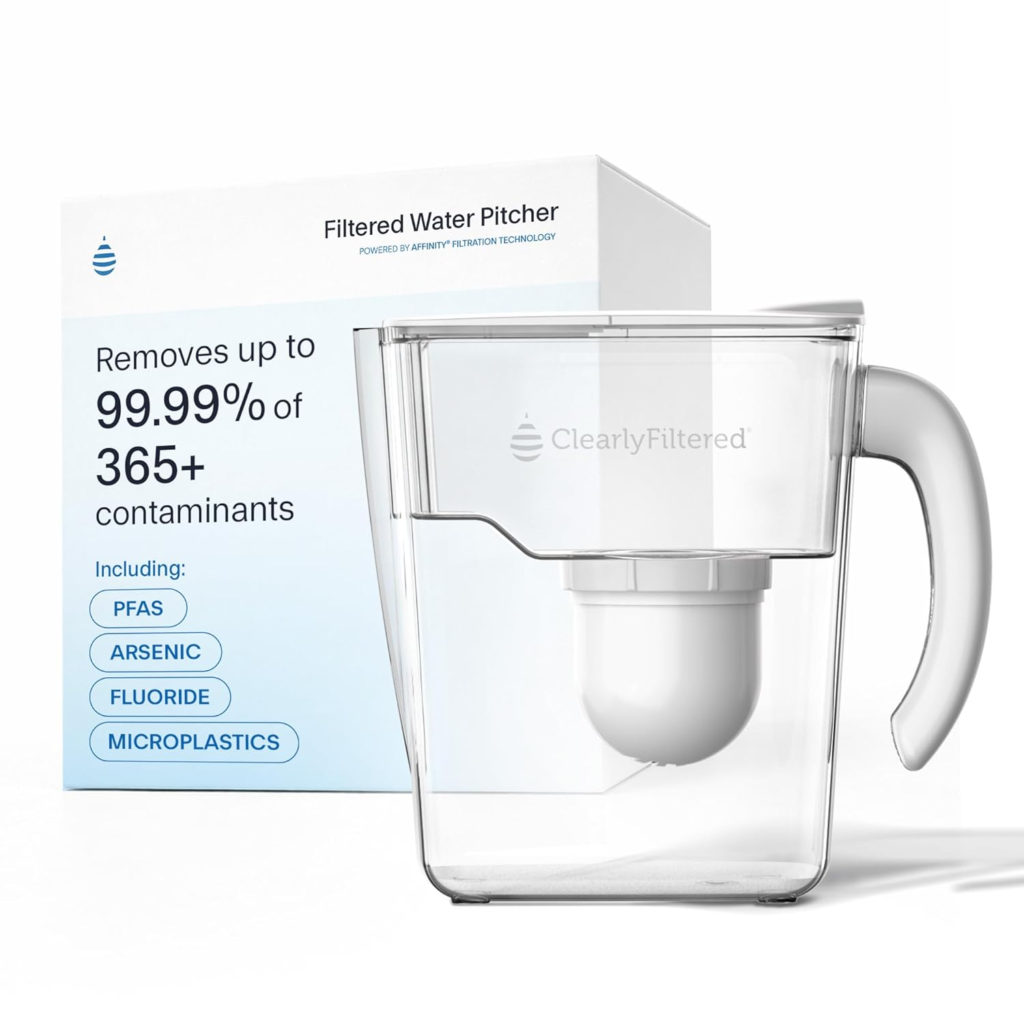
The standout in the pitcher category. Independently tested to remove 99.99% of microplastics and 365+ total contaminants — including fluoride, lead, PFAS, and pharmaceuticals — using a proprietary sub-micron filtration technology. It carries NSF/ANSI certifications 42, 53, 401, and P473, and is tested to the NSF 244 microplastic standard. No installation required. At ~$90 upfront, it’s the most capable pitcher filter we know of.
Best for: Renters, individuals, small households, people on a tighter budget, or anyone who wants effective protection without any installation.
Best Countertop RO: AquaTru Carafe
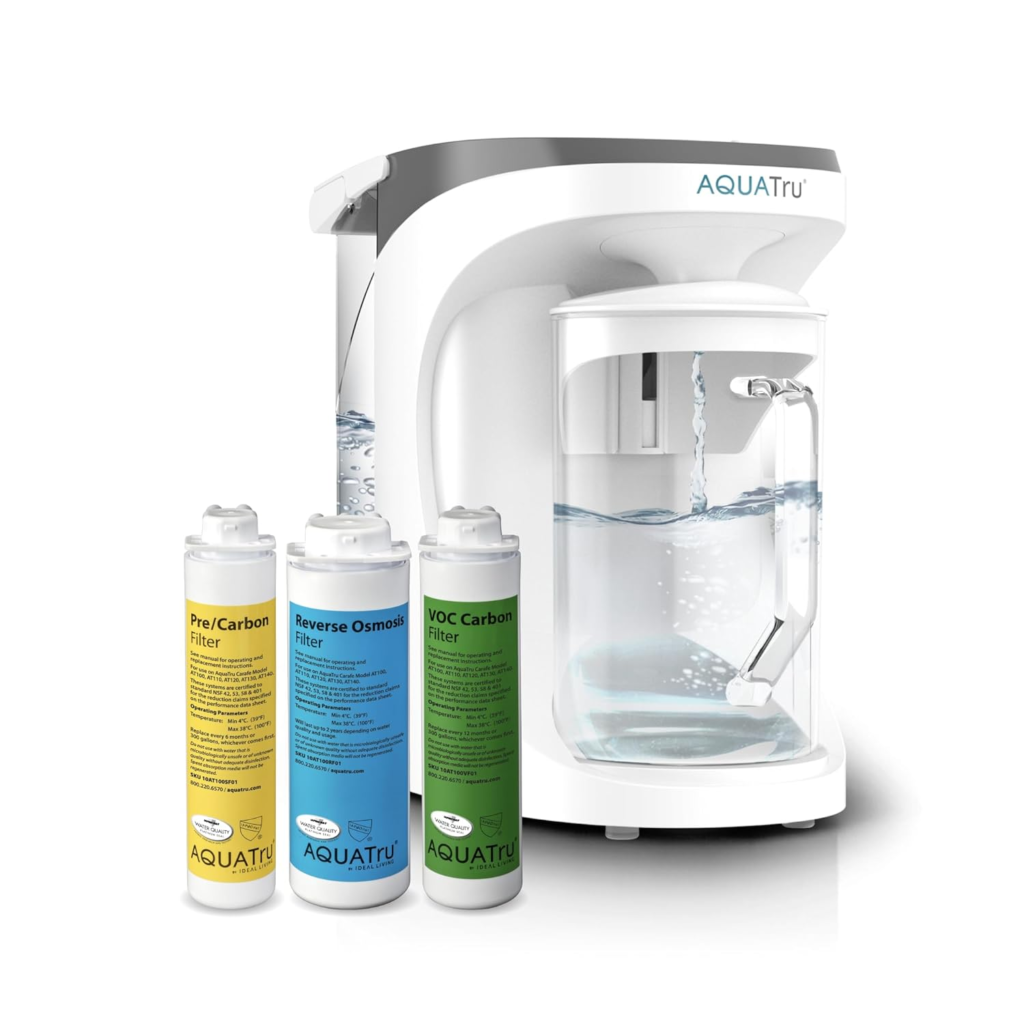
The only countertop RO system we know of that is independently certified to NSF standards 42, 53, 58, and 401 for every single contaminant it claims to reduce — 86 total. The glass carafe design means your purified water is stored in glass, not plastic, which matters when microplastic reduction is your goal. No plumbing required: just fill the top reservoir with tap water and let the system do its work. Highly efficient for an RO system at a 4:1 pure-to-waste ratio.
Best for: Renters or homeowners who want RO-grade filtration without installing anything, couples, small families, or anyone switching from bottled water.
Best Under-Sink RO: Waterdrop G3P800
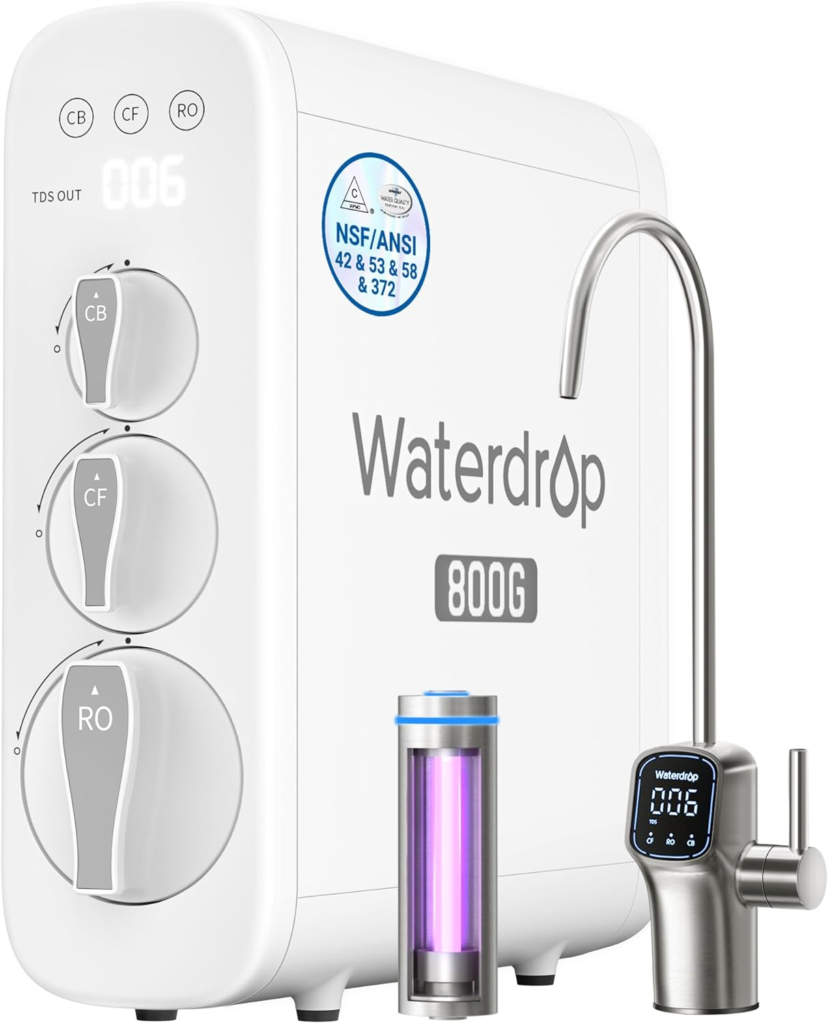
A tankless under-sink RO system with an 800 GPD flow rate, NSF/ANSI 401 certification for microplastic reduction, integrated UV sterilization, and a smart filter-life display. The tankless design eliminates the stagnant water storage risk of older RO systems. Filter changes take under a minute with a twist-and-lock cartridge design. Best value for families who go through a high volume of filtered water daily.
Best for: Homeowners, families of 3+, anyone who wants a permanent whole-kitchen solution with the highest throughput.
Decision Framework: Which One Is Right for You?
Answer these four questions and the right choice usually becomes obvious:
- Are you renting or do you own your home? If renting, a countertop RO (AquaTru) or pitcher (Clearly Filtered) is the easiest path, no installation, no landlord conversations.
- How many people are drinking filtered water? One or two people: a certified pitcher works well. Three or more: the slow gravity flow of a pitcher becomes a friction point. Countertop or under-sink RO makes more sense.
- What’s your budget? Under $150 to get started: Clearly Filtered pitcher. Have $300–$500 to invest and want the best long-term protection: AquaTru or Waterdrop.
- Are you also concerned about PFAS, fluoride, and heavy metals? If microplastics are your only concern, a certified pitcher covers you well. If you want comprehensive protection across the full spectrum of contaminants, RO is the more thorough solution.
One Thing to Avoid
The single worst move you can make is buying a standard carbon pitcher (a basic Brita Standard or PUR Classic, for example) and assuming it’s handling microplastics. It is not. These filters were designed for taste and odor improvement. Their carbon pore sizes are too large to reliably catch microplastic particles, and research confirms they don’t perform well for this specific contaminant.
If you already own one: it’s still better than nothing for overall water quality, but if microplastic reduction is your goal, it’s time to upgrade to a certified model. The Brita Elite is one exception, it holds an NSF/ANSI 401 certification for microplastic reduction, but it doesn’t match the breadth of protection offered by Clearly Filtered.
The Bottom Line
Both reverse osmosis and certified pitcher filters can meaningfully reduce your microplastic exposure from drinking water. RO wins on raw performance. Certified pitchers win on simplicity and upfront cost. The worst outcome isn’t choosing the “wrong” one between these two, it’s doing nothing, or grabbing a cheap uncertified filter and assuming the problem is solved.
Progress over perfection. Pick the one that fits your life and actually use it.
Sources
- Nguyen et al. (2023). Microplastic Removal from Drinking Water Using Point-of-Use Devices. PMC. Full text
- Frizzlife (2025). Water Filter for Microplastics: RO Buyer’s Guide. NSF/ANSI 401 certification overview. Full text
- WaterFilterGuru (2026). Best Water Filters for Microplastics — Lab Tested. AquaTru Carafe certification analysis. Full text
- QualityWaterLab (2025). Best Microplastic Water Filters — Lab Tested. Clearly Filtered and Waterdrop G3P800 testing data. Full text
- Clearly Filtered (2025). Pitcher Performance Data. IAPMO independent lab testing to NSF/ANSI standards. Full data sheet
- NSF International. NSF/ANSI Standard 401: Emerging Contaminants/Incidental Compounds. NSF.org
Affiliate disclosure: Some links in this article are affiliate links. If you purchase through them, nononano.com may earn a small commission at no extra cost to you. We only recommend products with independent NSF certification for microplastic removal.